Launched on the Tyne by Armstrong, Whitworth & Co on 29 April 1903, the SS Yongala was one of a pair of elegant coastal liners built for the Adelaide Steamship Company, alongside her sister Grantala. Named after a small town in South Australia, she first sailed the interstate route between Fremantle and Sydney before joining the Queensland coastal service. On 23 March 1911 she left Mackay bound for Townsville, carrying no wireless, and steamed into a cyclone she had no way of knowing about. She was never seen again, and all 122 people aboard were lost. Her fate remained a mystery until 1958, when local fisherman Bill Kirkpatrick located the wreck off Cape Bowling Green. Today she rests within the Great Barrier Reef Marine Park, a protected memorial and one of the finest wreck dives in the world. Another Queensland coast tragedy, the hospital ship AHS Centaur, was lost in 1943. Read about other famous Australian shipwrecks on our blog.
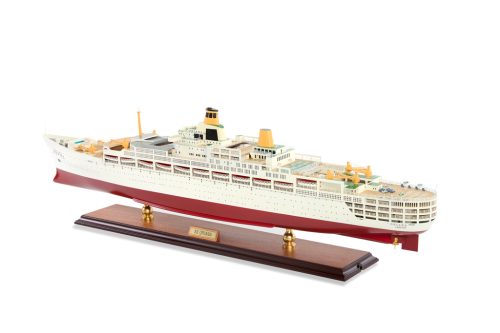
This handcrafted replica captures the graceful lines of an Edwardian coastal liner, from her long black hull to the tall funnel that once marked her across Australian ports. The warm glow of her LED lighting gives her a quiet, evocative presence after dark. She is a moving piece for Queensland families, divers who have explored the wreck, and collectors of Australian maritime history, and would sit proudly in a study, office or dive shop.
Key Features of the SS Yongala Model Ship 106cm (41.7″):
- Dimension: 106cmL x 22cmW x 45cmH or 41.7″L x 8.7″W x 17.7″H; approx. 1:105 Scale
- Handcrafted from start to finish by skilled craftsmen, using traditional plank-on-frame construction
- Built from quality timber, carefully selected and prepared to withstand changes in climate
- Hull shaped and sanded by hand, then finished in multiple layers of paint and varnish for a smooth, polished surface
- Black hull above a deep red lower hull, faithfully reflecting the classic livery of a coastal steamer of her era
- Paint scheme to match up with the real ship in every way, shape and form.
- Integrated LED lighting that brings the decks and superstructure to life after dark
- Comes with a strong wooden base and brass nameplate for display purposes.
- Suitable for display in a display case of your choosing (Display cabinet is sold separately.)
History of the SS Yongala
Built on the River Tyne by Armstrong, Whitworth & Co, the SS Yongala was launched on 29 April 1903 for the Adelaide Steamship Company, one of a pair of fine passenger and cargo liners ordered alongside her sister, Grantala. Named after a small town in South Australia, she offered accommodation for 110 first-class and 130 second-class passengers, and was fitted with electric lighting throughout, a mark of modern comfort at the time. After a delivery voyage by way of South Africa, she entered the interstate service linking Fremantle and Sydney via Adelaide and Melbourne, and later joined the busy coastal run to Queensland.
On 14 March 1911, the Yongala left Melbourne on her 99th voyage in Australian waters. She departed Mackay on the afternoon of 23 March, bound for Townsville, under the command of Captain William Knight. Shortly after she sailed, the Flat Top Island signal station received a warning of a cyclone between Mackay and Townsville, but the Yongala carried no wireless and could not be recalled. She was last sighted by the keeper of the Dent Island light as she entered the Whitsunday Passage, and was never seen again. All 122 people aboard were lost. Wreckage washed ashore along the coast, but the only body ever recovered was that of Moonshine, a racehorse being shipped north for the Townsville Cup.
For almost half a century, her resting place remained a mystery. In 1943, a Royal Australian Navy minesweeper snagged an unknown obstruction in the area, and in 1947 the survey vessel HMAS Lachlan recorded what was thought to be the wreck. In 1958, local fisherman Bill Kirkpatrick located the ship off Cape Bowling Green, and in 1961 a safe recovered from the purser’s cabin was traced by its serial number to the Yongala, confirming her identity. Today she lies about 48 nautical miles south-east of Townsville, within the Great Barrier Reef Marine Park. Protected under the Underwater Cultural Heritage Act 2018, she is regarded as one of the world’s great wreck dives and stands as a lasting memorial to all who were lost.


 CALL US 02 - 9522 7558
 EMAIL US info@seacraftgallery.com.au




There are no reviews yet.