The HMS Bounty was commissioned for a special mission of acquiring breadfruit plants for Royal Navy from Tahiti. Sent under the stewardship of William Bligh, sailing halfway around the world to Tahiti and back to the coast of England, the ship never completed its original mission due to an incident mutiny commonly known as the mutiny on the Bounty.
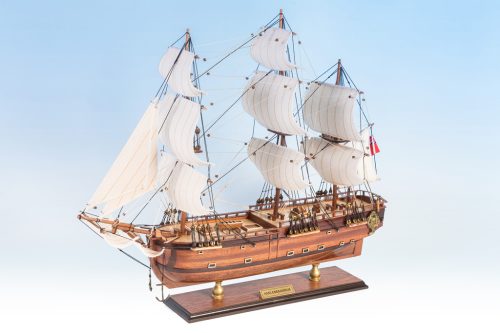
It’s a fantastic choice of decoration with 50cm HMS Bounty model ship. Handcrafted and designed to deliver the best possible take on the real thing, these HMS Bounty ship models offer you a glimpse into the maritime trading of the past.
Key Features of the HMS Bounty Ship Model:
- Impressed take on the ship, leaving you with an HMS Bounty model ship as close to the real thing as possible.
- One of our most popular model ships for sale, this is a 50cmL x 14cmW x 45cmH or 19.7″L x 5.5″W x 17.7″H replica in approx. 1:55 scale.
- Attention to detail on the layout, scale and materials used on the ship.
- Made from individual wooden planks and high quality wood & metal throughout.
- Gun ports cut directly into the hull, not stuck on.
- All decorative details – cannons, anchors and decorative linings are metal-sculpted for the best look. No plastic used.
- Deck features help to add attention to detail with realistic extras such as lifeboats and steering wheel are included.
- All sails are made using impressive fine linen and rigging lines of various formats.
- Solid and safe wooden base which comes with a metal name plate and a laminated fact sheet.
The HMS Bounty ship model is also available in 75cm. You may consider to purchase a display cabinet to protect the model ship from dust and damage.
About the HMS Bounty
Once known as the Bethia, this collier was used for several smaller jobs prior to being bought out by the Royal Navy. Bought thanks to its full-rigged status despite being quite small, it became an essential part of the 1787 breadfruit expedition. The idea came through the work of Sir Joseph Banks, who wanted to use breadfruit to grow cheap, simple food for the slaves of the era. Putting William Bligh in command of the ship, it was re-fitted for purpose and set off on its voyage.
With 46 men on board under Bligh, it was seen as the perfect trip to take. Few naval ships of the era are quite so recognisable and stand-out as that of the HMS Bounty. It was first put to sea for the expedition in 1787, leaving England in search of Tahiti in the South Pacific. On its journey, it was to pick up some breadfruit sapling and to take them over to the West Indies. It would serve as food for the many poor people trapped in enslavement. The Bounty finally arrived in late 1788, after a long journey, and stuck around for many months.
Under the oppressive command of the infamous Bligh, though, the HMS Bounty was a ship that had endured multiple issues. Known as a notorious bully, Bligh was disliked by much of the people aboard his ship. Though some sources paint him in a slightly more lenient light, his appointment came due to his patronage of Sir Joseph Banks as well as his sailing experience alongside James Cook. Alongside his Master’s Mate, Fletcher Christian, there was much uncertainty throughout the crew. Indeed, Fletcher even married a local Tahitian, known as Maimiti.
Five months were spent in Tahiti, when they were expected to sail off. On 28 April 1789, the ship was seized in a mutiny led by Christian. Bligh and 18 loyal men were forced into the ship’s open launch, which Bligh navigated more than 3,600 nautical miles to Timor, arriving in June 1789. Bligh later completed the breadfruit mission on his second voyage, aboard HMS Providence, between 1791 and 1793.
The mutineers first tried to settle on Tubuai but were driven off, and returned to Tahiti. Christian and eight others, with a group of Tahitians, then sailed on to remote Pitcairn Island, where they stripped and burned the Bounty in January 1790. Those who stayed on Tahiti were captured when HMS Pandora arrived in March 1791. On 29 August 1791, Pandora was wrecked on the Great Barrier Reef, off the coast of Queensland, and four of the prisoners drowned; the survivors were taken to England for court martial.
The Pitcairn settlement remained undiscovered until the American ship Topaz arrived in 1808, by which time only one mutineer, John Adams, was still alive. Many of Pitcairn’s present-day inhabitants are descended from the mutineers and their Tahitian companions. Bligh himself went on to serve as Governor of New South Wales from 1806 to 1808, when he was deposed in the Rum Rebellion.
This model is also available in a larger 75cm size. William Bligh had earlier sailed with Captain James Cook, whose HMB Endeavour is also in our collection.



 CALL US 02 - 9522 7558
 EMAIL US info@seacraftgallery.com.au




There are no reviews yet.